


More Than Mushrooms: Meet Niah, a Curious Mind Rooted in Nature
About the Author: Christina Hill
My journey with the market began in 2018, leading weekly cooking demonstrations. Since then, I’ve served as the Marketing & Communications Specialist, taught yoga at the market, and joined the Board of Directors. If you’ve been with us since the Countryside Farmers Market days, there’s a good chance you’ve read some of my work already. I’m thrilled to be in a position where I can continue to share my love for local food with you.
Recently, I spent over an hour at the market talking with Niah Cohen. We got into the topics of cultivating and forging mushrooms, cooking with mushrooms, and what it’s like for her to be living a bit of an untraditional life for someone of her age. The following is a recap of our chat. I hope you enjoy!
Some people follow a traditional path. Others follow their curiosity. For 23-year-old Niah, that curiosity just happens to lead into the woods.
There are a few things you can count on at the Cuyahoga Valley Farmers Market on a Saturday morning. Fresh produce, familiar faces, and conversations that have a way of turning into something much more interesting than you expected.
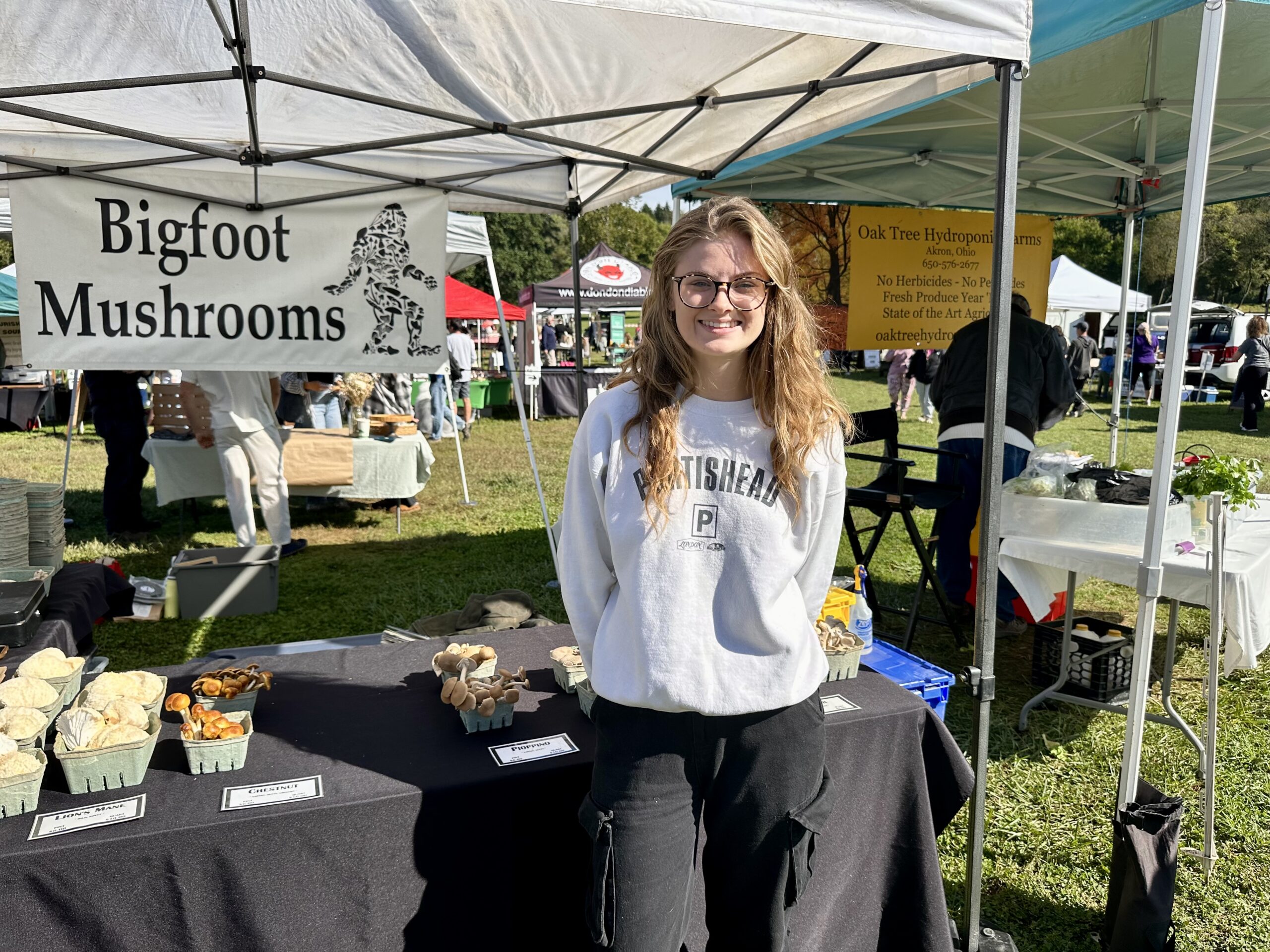
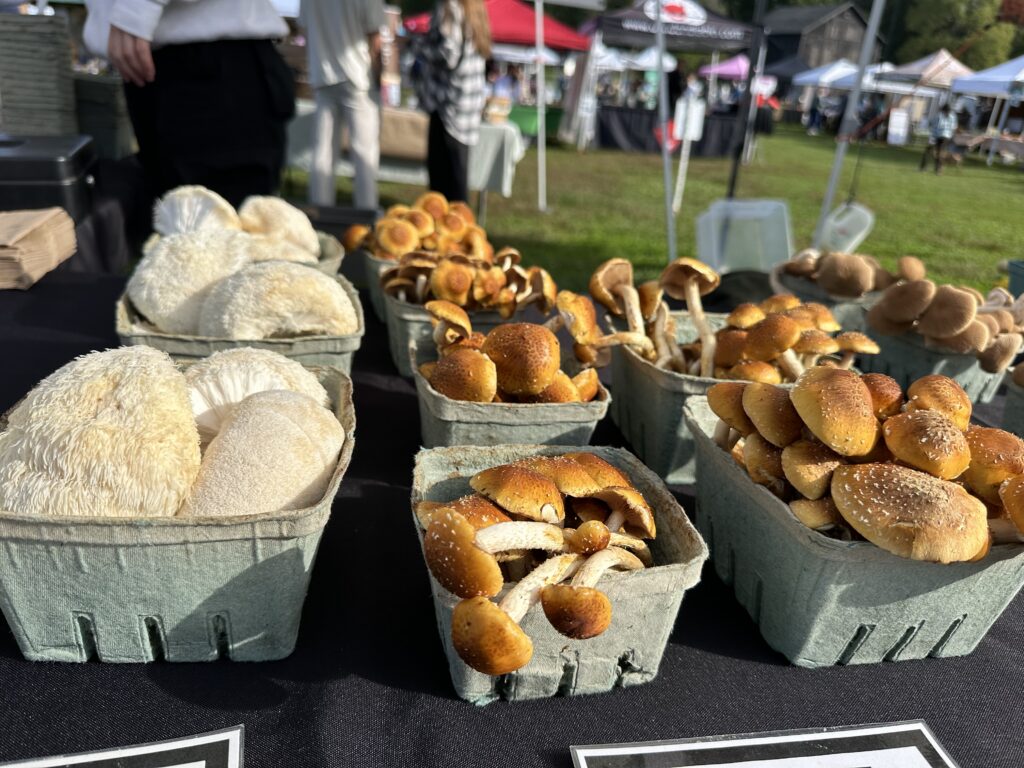
This particular morning, I find myself at the Bigfoot Mushrooms booth, surrounded by mushrooms in shapes and textures that look like they belong in a storybook.
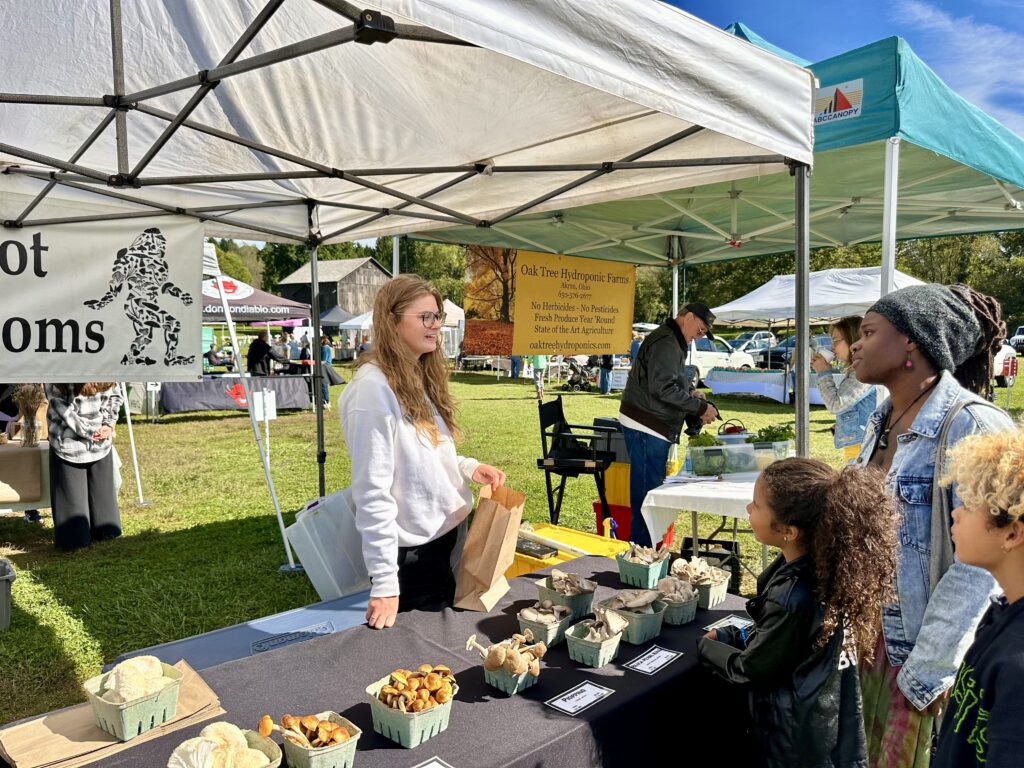
A customer wants to know which variety would be best on a steak. Another is curious about growing mushrooms at home. Someone else is trying to wrap their head around the fluffy, almost otherworldly appearance of lion’s mane.
And behind the table is Niah, enthusiastically answering every question while somehow managing to have an entirely separate conversation with me.
Niah is one of the friendly faces representing Bigfoot Mushrooms, a gourmet mushroom farm in South Newbury, Ohio, founded by Joey Dahlhausen in 2020.
Joey is the man behind the operation, cultivating the beautiful varieties that fill the market table each week. Niah, who has spent time working alongside him in the cultivation process, brings her own wealth of knowledge and infectious enthusiasm to the booth.
And what a delightful combination it is.
She’s 23, doesn’t use social media, spends much of her time working outdoors, and knows more about fungi than I could possibly hope to squeeze into a Saturday morning conversation.
Within the first few minutes, I realize two things. First, I know very little about mushrooms. And second, Niah is exactly the kind of person I love meeting at the farmers market.
Because her story isn’t really about selling mushrooms. It’s about what happens when you become so genuinely curious about something that learning stops feeling like an obligation and starts becoming a way of life.

A Different Kind of Education
When I ask Niah what she does, I don’t get a particularly straightforward answer.
She works on farms, does landscaping, cares for plants, reads, researches, forages, and generally seems to spend every available moment learning something new.
She’s studied environmental science, biology, and chemistry, worked in a mycology lab, and even participated in research exploring how certain fungi might help farmers protect their crops from agricultural pests.
In other words, while most of us are trying to figure out which mushrooms taste best in an omelet, Niah has been studying how fungi might help solve problems in agriculture.
But perhaps the most interesting part of her education is that she ultimately decided the traditional college path wasn’t for her.
Not because she lost interest in learning. Quite the opposite.
“I think because of how passionate I am and how deep I want my knowledge to go, school isn’t the best place for me anymore,” she explains.
She found herself questioning how much time she spent commuting, sitting through lectures, and preparing for exams compared to the time she could spend researching and gaining hands-on experience.
So she chose a different path.
It’s a decision she acknowledges isn’t necessarily right for everyone. But for someone with an almost insatiable appetite for knowledge, she discovered that education doesn’t have to exist within the walls of a classroom.
And listening to her talk, it’s hard to argue that she isn’t learning.
The Fascinating World Beneath Our Feet
Before meeting Niah, I thought I had a fairly decent understanding of mushrooms.
They grow in the woods. Some are edible. Some definitely aren’t. And the good ones are delicious sautéed in a little butter and garlic.
As it turns out, that’s barely scratching the surface.
One of the first things Niah explains is that the mushroom we see growing above ground is only one part of a much larger organism.
The mushroom itself is the fruiting body of a fungus. Beneath it, often hidden in soil or decaying wood, is an intricate network of threadlike structures called mycelium.
Think of mycelium as something resembling a root system, although technically, fungi don’t have roots.
These networks can spread through enormous areas, breaking down organic matter, recycling nutrients, and forming relationships with plants and other organisms. Some even partner with tree roots, helping plants access water and nutrients in exchange for sugars.
And here’s where things get really interesting.
Some fungal networks are so extensive that they’re considered among the largest individual organisms on Earth, stretching underground across vast areas.
All of this happening beneath our feet, largely unnoticed.
As Niah explains how fungi interact with the world around them, our conversation drifts into something a little more philosophical.
We talk about how nature doesn’t always fit neatly into the categories humans create. How fungi, plants, bacteria, and countless other organisms exist in relationships with one another.
“It takes a lot of things,” she says. “We’re all working together, and we’re all, at the end of the day, connected.”
I couldn’t help but smile.
Here I was, expecting to learn about mushrooms, and somehow we’d ended up talking about the interconnectedness of life.
But maybe that’s exactly what makes fungi so fascinating. The more you learn about them, the more you realize how much of the natural world depends on relationships we rarely stop to consider.
A Walk in the Woods Looks a Little Different
If you’ve ever walked through the woods after a good rain, you’ve probably noticed mushrooms popping up seemingly overnight.
According to Niah, there’s a reason for that.
Moisture is one of the most important factors influencing mushroom growth, and the combination of rainfall and cooling temperatures makes autumn in Northeast Ohio a particularly exciting time to pay attention.
“This is peak mushroom foraging season in Ohio,” she tells me.
Depending on the weather, fall can bring an abundance of fascinating species, including hen of the woods, chicken of the woods, oyster mushrooms, and lion’s mane. Spring, meanwhile, is famous for its highly sought-after morels.
But successful foraging requires more than simply looking at the ground.
One of Niah’s biggest recommendations for aspiring mushroom enthusiasts is to learn about trees.
Different fungi have relationships with different tree species, and recognizing those associations can completely change the way you explore a forest.
Instead of wandering aimlessly hoping to spot something interesting, you begin noticing the landscape differently.
The trees. The moisture. The fallen logs. The changing seasons.
“Overall, just getting more tapped in with the land around you helps,” she explains.
I love that.
Because even if you never harvest a single mushroom, there’s something incredibly rewarding about walking through the woods with a little more awareness.
Suddenly, a fallen tree isn’t just a fallen tree. It’s an entire ecosystem. A cluster of mushrooms becomes an invitation to stop, look closer, and ask questions.
And if you happen to spot a lion’s mane mushroom growing high in a tree, you might just understand why Niah has occasionally found herself climbing after one.
Although I think I’ll stick to admiring them from the ground for now.
An important note on foraging: Some wild mushrooms are dangerously poisonous, and edible species can have look-alikes. Never rely on AI or a single source for identification, and only consume wild mushrooms identified with certainty by a qualified expert. Always follow local regulations, too. Mushroom collecting is prohibited within Cuyahoga Valley National Park, but there’s plenty to discover through observation and photography!

From Forest Floor to Frying Pan
Of course, after spending so much time talking about mushrooms in the wild, I have to ask the question that’s probably on most people’s minds.
What’s the best way to eat them?
Niah doesn’t hesitate to share her love for oyster mushrooms.
They’re versatile, flavorful, and can take on wonderfully different textures depending on how they’re prepared. She especially loves cooking them until they’re golden and crispy, often tossing them into vegetable sautés or pairing them with eggs.
But oysters are only the beginning.
Lion’s mane is another favorite, with its shaggy appearance and tender, meaty texture. Niah likes tearing it apart by hand rather than slicing it, creating little ridges that catch sauces and marinades beautifully. It’s wonderful pan-seared, grilled, or shredded into sandwiches.
Chestnut mushrooms bring a slightly nutty flavor and satisfying texture when cooked, making them a favorite in Niah’s Asian-inspired dishes with plenty of garlic and onions.
One thing I love about listening to Niah describe cooking mushrooms is how much she appreciates their individuality.
Some are delicate. Others are hearty. Some crisp up beautifully, while others soak up flavorful sauces.
They’re not simply an ingredient you throw into a pan. They’re something worth getting to know.
And if you’re feeling particularly adventurous, Bigfoot Mushrooms even offers grow kits that allow you to cultivate your own mushrooms at home.
With a little indirect light, proper moisture, and a few simple steps, you can watch mushrooms emerge right from the bag.
Of course, getting those mushrooms to the market table in the first place is a much bigger undertaking.
Niah walks me through the cultivation process at Bigfoot Mushrooms, describing everything from preparing the growing medium to carefully managing moisture, temperature, and airflow.
She even tells me about a machine Joey built himself to streamline the process of filling their grow bags.
Pretty impressive, if you ask me.
It’s clear there’s a whole lot of knowledge, ingenuity, and hard work behind those beautiful clusters of mushrooms. And thanks to Joey and the Bigfoot Mushrooms crew, we get to enjoy the fruits (or should I say fungi?) of that labor right here at the market.
More Than a Hobby
As our conversation winds down, I find myself wanting to know a little less about mushrooms and a little more about the person standing in front of me.
Because there’s something refreshing about meeting someone so young who seems genuinely comfortable following a path that looks different from what society typically expects.
At 23, Niah isn’t particularly concerned with building a social media presence or following a conventional career trajectory.
She’s interested in learning. Working with her hands. Spending time outside. Understanding the natural world. And surrounding herself with people who share those interests.
When I ask what advice she’d give someone who feels drawn toward an unconventional path, her answer is simple.
“Just keep following your passions.”
She laughs a little, acknowledging that it might sound like generic advice.
But as she continues, it becomes clear there’s a lot more behind those words.
She talks about trusting your interests, learning as much as you possibly can, and believing that the right people and opportunities have a way of finding you when you’re genuinely invested in what you’re doing.
“Every single field has infinite depth to it,” she tells me.
And that sentence sticks with me.
Because I think it’s easy to reach a point in life where we stop being curious. We learn what we need to know to do our jobs, manage our responsibilities, and get through our days.
But how often do we allow ourselves to become completely fascinated by something simply because it interests us?
To pick up a book with no intention of earning a grade. To spend an afternoon exploring the woods with no particular destination. To ask questions just for the joy of discovering the answers.
Niah reminds me that curiosity doesn’t have to lead somewhere impressive to be worthwhile.
Sometimes, the learning itself is enough.
And sometimes, when you follow that curiosity long enough, it leads you somewhere you never could have planned.
Staying Connected to What Matters
One of the last things Niah shares with me is how she first learned to forage.
Her grandfather taught her.
It’s a small detail, but one that adds another layer to everything we’ve been discussing.
For Niah, foraging isn’t simply a hobby or a way to find interesting ingredients. It’s knowledge passed from one generation to the next. Knowledge that connects people to the land, their food, and one another.
And suddenly, our conversation has come full circle.
From the intricate networks of mycelium beneath the forest floor to the relationships between people, plants, food, and generations.
Connection seems to be the common thread.
Before I leave, another customer approaches the booth with a question about mushrooms. Niah turns toward them, just as enthusiastic as she was when our conversation began.
I walk away thinking about how much I learned in that short time, but even more about how much there still is to discover.
Maybe that’s the real beauty of curiosity.
The more closely we look, the more we realize how much we’ve been overlooking.
And sometimes, all it takes is a conversation with a 23-year-old mushroom enthusiast to remind us.
Come Get a Little Fungi With Us!
If Niah has sparked your curiosity about the wonderful world of mushrooms, you’re in luck!
Join us on Saturday, October 24, at Howe Meadow for the Cuyahoga Valley Farmers Market’s Fungi & Fermentation Fest.
We’ll be celebrating all things fungi and fermentation with local growers, demonstrations, fermented foods, and a special appearance by chef Jeremy Umansky.
And yes, there’s a mushroom costume contest. Because why not?
Explore Fungi & Fermentation Fest →
Next time you’re at the market, stop by the Bigfoot Mushrooms booth to explore the beautiful mushrooms Joey and his team cultivate. And if Niah happens to be behind the table, strike up a conversation. You might come looking for something delicious to cook for dinner and leave with a whole new appreciation for the fascinating world of fungi.